Module Description
Islamic Law – Physical Purification

Module Instructor
“The scholars are the inheritors of the prophets.” [Abu Dawud]

Module Details
All our Saturday classes are available both in person and online. As an institute, we strongly encourage students to attend in person, as the benefits of in-person learning far exceed those of online attendance. The Friday sessions are conducted online via Zoom.
Location
Online Zoom: links will be provided via email
Date/Time
Starting – 10th April 2026 for 10 weeks
Fridays – 8.10am to 8.50pm
Module Content
Course content will only show once you re logged in.
Module Text: Ascent to Felicity, A manual on Islamic Creed and Hanafi Jurisprudence.
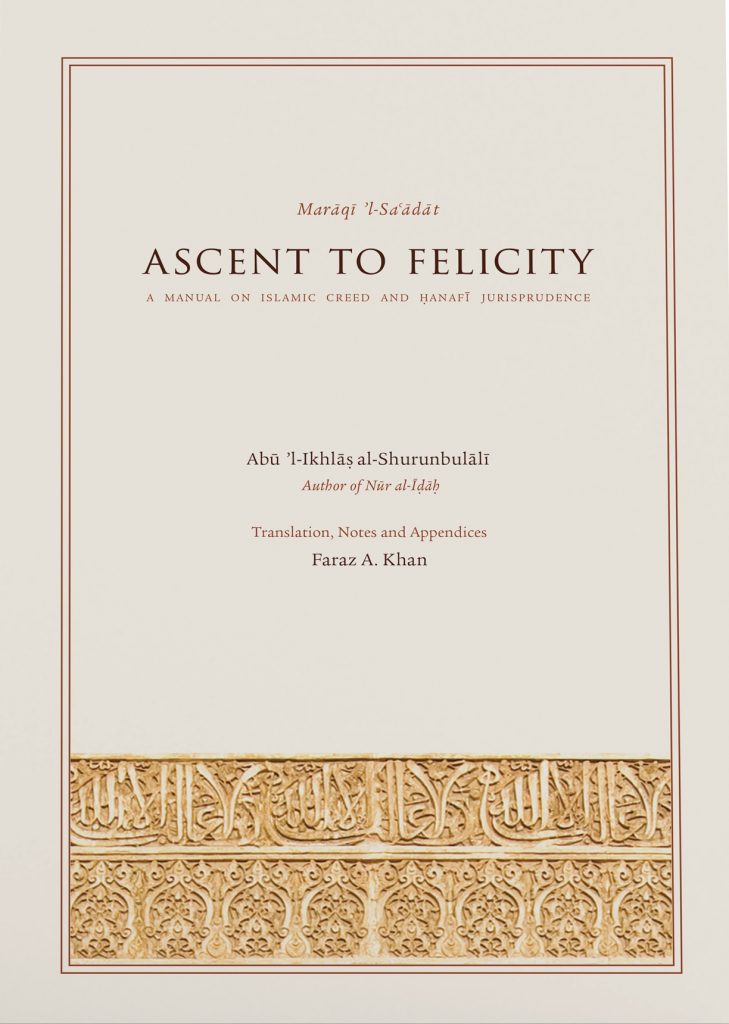
Written by the eminent 11th century Hanafi scholar, Abu ’l-Ikhlas al-Shurunbulali, Ascent to Felicity is a concise yet comprehensive primer in creed and jurisprudence. It spans all five pillars of Islam, as well as the topics of slaughtering, ritual sacrifice, and hunting. To supplement the text, the translator has added key explanatory notes taken from several reliable works on theology and jurisprudence. He has also added appendices that comprise numerous supplications related to the five pillars, presented in Arabic script along with English transliteration, as well as the etiquette of visiting the Messenger of Allah (Allah bless him and give him peace) in Madina Munawwara.
Text Author: Imam Abu Al-Ikhlas Hasan ibn Ammar Al-Shurunbulali al- Hanafi
Born in a village in Upper Egypt in 994/1586, his father took him to Cairo at the tender age of six. He memorized the Qur’an and subsequently studied the Islamic sciences under numerous scholars, specifically Qur’anic recitation under Shaykh Muhammad al-Hamawi and Shaykh ‘Abd al-Rahman al-Masiri, and jurisprudence under Imam ‘Abdullah al-Nahriri, ‘Allama Muhammad al-Mahabbi, and Shaykh ‘Ali ibn Ghanim al-Maqdisi. He then went to Azhar University, which at that time was the sanctuary for advanced students. He pursued higher education there and surpassed his peers, for he was foremost in his knowledge of juridical passages and maxims. Word spread of his rank and skill, and he eventually became one of the most renowned juristconsults of the entire Muslim world. He assumed the post of professor at Azhar, whereby numerous aspiring students sat at his feet and benefited from his knowledge, many of whom themselves later developed into notable scholars of law. These included, from Egypt, ‘Allama Ahmad al-’Ajmi, Sayyid Ahmad al-Hamawi, Shaykh Shahin al-Armanawi, and from the Levant, ‘Allama Isma’il al-Nablusi (father of the illustrious saint and jurist, Shaykh ‘Abd al-Ghani al-Nablusi). Moreover, the high demands and taxing lifestyle of his roles as professor, jurisconsult (mufti) and jurist, did not in the least take away from his occupation as writer. He authored over sixty works, ranging from the aforementioned two commentaries, as well as his distinguished Shurunbulaliyya, to numerous smaller treatises covering an array of specialized legal matters.
You must log in and have started this course to submit a review.