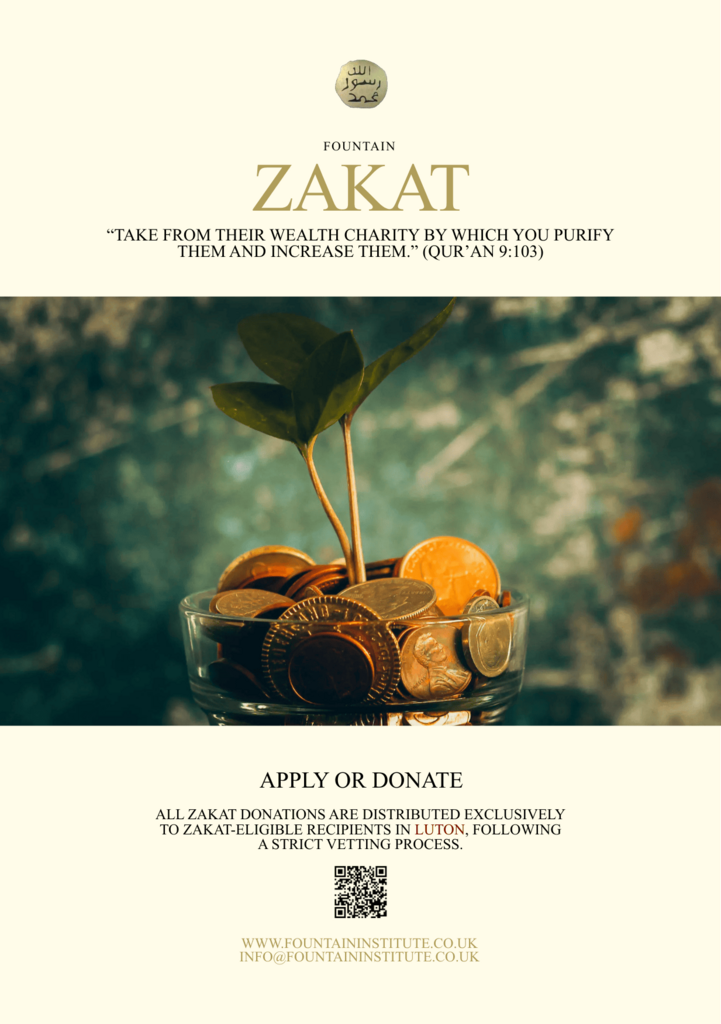

Zakat
Fountain Zakat operates with a 100% donation policy, ensuring your zakat goes directly to local recipients. All applicants are carefully vetted through a detailed process to confirm their eligibility. We engage directly with them to understand their needs and provide the most effective support.
Maximize your zakat rewards by entrusting us with your contribution. Through Gift Aid, we enhance each donation, reinvesting 100% back into the community to support Islamic education. This initiative enables countless individuals to study the religion at no cost.
What sets us apart is our commitment to distributing zakat exclusively within the local community. This ensures that those facing difficulties right on our doorstep receive the care and support they need.
Distributing Zakat locally
قالَ ابن عباس قالَ رَسولُ اللَّهِ ﷺ لِمُعاذِ بنِ جَبَلٍ حِينَ بَعَثَهُ إلى اليَمَنِ: إنَّكَ سَتَأْتي قَوْمًا مِن أهْلِ الكِتابِ، فَإِذا جِئْتَهُمْ فادْعُهُمْ إلى أنْ يَشْهَدُوا أنْ لا إلَهَ إلّا اللَّهُ، وأنَّ مُحَمَّدًا رَسولُ اللَّهِ، فإنْ هُمْ طاعُوا لكَ بذلكَ، فأخْبِرْهُمْ أنَّ اللَّهَ قدْ فَرَضَ عليهم خَمْسَ صَلَواتٍ في كُلِّ يَومٍ ولَيْلَةٍ، فإنْ هُمْ طاعُوا لكَ بذلكَ فأخْبِرْهُمْ أنَّ اللَّهَ قدْ فَرَضَ عليهم صَدَقَةً، تُؤْخَذُ مِن أغْنِيائِهِمْ فَتُرَدُّ على فُقَرائِهِمْ، فإنْ هُمْ طاعُوا لكَ بذلكَ فَإِيّاكَ وكَرائِمَ أمْوالِهِمْ، واتَّقِ دَعْوَةَ المَظْلُومِ، فإنَّه ليسَ بيْنَهُ وبيْنَ اللَّهِ حِجابٌ
Narrated Ibn `Abbas: The Prophet (ﷺ) sent Mu`adh to Yemen and said, “Invite the people to testify that none has the right to be worshipped but Allah and I am Allah’s Messenger (ﷺ), and if they obey you to do so, then teach them that Allah has enjoined on them five prayers in every day and night (in twenty-four hours), and if they obey you to do so, then teach them that Allah has made it obligatory for them to pay the Zakat from their property and it is to be taken from the wealthy among them and given to the poor.”
Reference: Sahih al-Bukhari 1395, In-book reference: Book 24, Hadith 1
Donate Today
The whole process has been in line with our teachers to ensure the correct rules and processes have been applied according to the Hanafi School of thought. We continue to consult the teachers for each Zakat applicant to ensure the correct rules have been applied. We are confident that we will deliver your zakat to individuals who are 100% eligible.
Zakat Application Form:
To be eligible for Zakat assistance, residency in LUTON is a requirement, and the provided form must be filled out. Ensure that all fields are duly completed and someone will get in touch.
Current Nisab rates for Gold & Silver
Saturday 7th March 2026

Gold: £9,761.99
(Based on Gold price of £111.59 per gram

Silver: £1118.78
(Based on Silver price of £1.83 per gram)
Feedback
I would like to begin by thanking and praising Allah (SWT). May Allah (SWT) reward you all, bless you all, aid you all, protect you all, and accept all your du’as. جزاكم اللهُ خيرًا بارك الله فيكم.
I am a full-time mother of six and a practicing Muslim. Two years ago, my husband and I separated, and as he was the main breadwinner, I was left facing very difficult financial circumstances. I accumulated significant debts, including rent arrears, council tax arrears, and other essential bills. During this time, I was under immense pressure and severe stress, which affected my mental health, and I was placed on medication for anxiety and depression. My life felt like it was falling apart.
In this extremely difficult period, I cannot express enough gratitude to the Fountain Zakat Fund, the Fountain Institution, and the entire Fountain team. Their support, advice, and compassion were life-changing for me and my children. They assisted us not only with financial support, but also with food parcels and hot meals during some of our most difficult moments. Their kindness, professionalism, and care were beyond what words can fully capture. My children and I make du’a for the entire Fountain team constantly. May Allah (SWT) accept these du’as from us and reward them immensely for everything they have done.
They are truly an exceptional organisation—kind, compassionate, respectful, and dedicated to helping those in need. I would strongly encourage others to support them so they can continue and expand their vital work, including establishing a permanent premises of their own. They are not only helping individuals, they are strengthening communities and embodying the true essence of Islam and mercy. I am forever grateful, forever thankful, and deeply indebted to them for the support they provided during Ramadan, Eid, and beyond. جزاكم اللهُ خيرًا بارك الله فيكم.
The application process went smoothly without any issues, and the website was easy to use, Fountain Institute supported me with zakat funds during my financial difficulties and my family’s, helping us purchase home furniture, personal items, and also pay off debts.
This assistance has made a significant difference for me and my family, greatly easing our burdens and reducing our living expenses. May God bless you, your wealth, your work, and your children, and grant you more of His grace and generosity. AbdoBeing separated, I struggled to meet my bills, especially with my mortgage constantly increasing. I needed assistance to cover expenses and provide for my children.
Fountain Zakat provided monthly support for over a year, easing my financial burden significantly. With their help, I could manage bills and afford essential groceries. This aid allowed me to gradually reduce my mortgage and regain financial stability without constantly seeking assistance.
I highly recommend Fountain Zakat for their prompt and supportive assistance. Their help has been invaluable, allowing me to regain control of my finances and handle expenses without accruing debt or relying on friends.
I am deeply grateful for their ongoing support, which has empowered me to stand on my own feet again. Thank you immensely for everything.
Frequently Asked Questions
This passage is a fiqh (Islamic jurisprudence) section explaining the rulings of Zakat and Ṣadaqat al-Fiṭr, including the definition of zakat, the minimum wealth required (niṣāb), who must pay it, who can receive it, and the rules for the charity given at the end of Ramadan.
It is from the Hanafi fiqh manual Ascent to Felicity (Marāqī al-Saʿādāt) by Shurunbulali, in the chapter called “Kitāb al-Zakāt (The Book of Zakat)”.

What Zakat Is?
Zakat is defined as the transfer of ownership (tamlik) of a specific portion of wealth that the Lawgiver has prescribed to a specific eligible person, with the intention of fulfilling the obligation. Because zakat is an act of worship rather than merely a tax, intention (niyyah) is required when paying it. The recipient does not need to know it is zakat; it may be given in the form of a gift or loan while intending zakat internally.
Zakat is an obligatory act of worship where a Muslim gives a portion of their wealth to eligible recipients.
Key points:
It is 2.5% of qualifying wealth.
It becomes obligatory when:
– A Muslim is adult and sane.
– They own wealth equal to or above the niṣāb.
– That wealth remains for one lunar year.
It must be given with the intention of Zakat.
What Is Niṣāb (Minimum Amount)?
Niṣāb refers to the minimum amount of wealth that determines zakat rulings. The text explains two types:
Niṣāb for obligation (niṣāb wujūb al-zakāt): the minimum amount of zakatable wealth that makes zakat obligatory.
Niṣāb preventing eligibility (niṣāb ḥirmān al-zakāt): the minimum amount of total wealth that makes someone ineligible to receive zakat, even if they themselves are not required to pay it.
This second type may include wealth beyond zakatable categories, such as property not purchased for trade.
Niṣāb is the minimum wealth required before Zakat becomes obligatory.
Examples:
Gold: about 87.5 g
Silver: about 612 g
If your total wealth equals or exceeds this amount for one lunar year, Zakat becomes due.
Zakatable wealth includes
– Cash
– Gold and silver
– Trade goods
– Livestock (special rules)
Not included:
– Your house
– Clothes
– Furniture
– Car
– Tools for work
– Personal belongings
Conditions for Paying Zakat?
Zakat is obligatory on a free Muslim who is adult and sane and possesses the niṣāb in monetary wealth or trade goods. The wealth must remain for one full lunar year (ḥawl) and must be beyond debts owed to people and basic personal needs. Debts related to religious duties (such as expiation or vows) are not deducted when calculating zakatable wealth.
Zakat is due when:
1️⃣ You own wealth equal to niṣāb
2️⃣ One lunar year has passed
3️⃣ Wealth is beyond basic needs
4️⃣ Wealth is after debts are deducted
Who Can Receive Zakat?
The Qur’an lists specific categories.
Eligible recipients include:
– Poor person (faqīr) – has some wealth but below niṣāb
– Extremely poor (miskīn) – has nothing
– Slave freeing themselves (mukātib)
– Person in debt
– Stranded soldier
– Stranded pilgrim
– Traveler without money
– Zakat collectors appointed by the state
You may give Zakat to one person or multiple people.
Who Cannot Receive Zakat?
Zakat cannot be given to:
❌ Non-Muslims (with some exceptions for ṣadaqat al-fiṭr in this text)
❌ A wealthy person
❌ Your parents or grandparents
❌ Your children or grandchildren
❌ Your spouse
❌ Your own slaves
❌ The Prophet’s clan (Hashimites according to this school)
Also, Zakat cannot be used for:
– Building mosques
– Hospitals
– Roads
– Public projects
Because Zakat requires transfer of ownership to a person.
Who Should You Prefer to Give Zakat To?
Preferred order:
1.) Poor relatives
2.) Neighbours
3.) People in your local area
4.) People of your profession/community
5.) People of your city
Helping relatives with Zakat is especially recommended.
Giving Zakat to Someone Far Away
It is disliked to transfer zakat to another region once the lunar year has passed, particularly when poor people exist locally. However, exceptions include:
– Relatives living elsewhere
– Individuals with greater need
– People with stronger religious devotion
– Those who benefit the Muslim community (such as teachers)
Ṣadaqat al-Fiṭr (Charity at the End of Ramadan)
This charity is obligatory before Eid al-Fiṭr.
– Who must pay it:
Every adult Muslim who possesses niṣāb-level wealth beyond basic needs.
A man pays on behalf of:
– Himself
– His minor children
– His slaves (historical context)
Amount of Ṣadaqat al-Fiṭr
The prescribed amounts are:
Half a ṣāʿ (about 2.2 kg) of wheat or wheat flour
OR
One ṣāʿ (about 4.4 kg) of dates, barley, or raisins.
The text states it is permissible—and often superior—to give the monetary value, because this may better fulfil the needs of the poor. However, in times of hardship or famine, giving actual food may be preferable.
When to Pay Ṣadaqat al-Fiṭr
Ṣadaqat al-Fiṭr becomes obligatory at dawn (fajr) on the day of Eid al-Fiṭr. The preferred time to pay it is before leaving for the Eid prayer, although it remains valid if paid before or after that time. Delaying it unnecessarily is considered disliked.
To apply, you must be a Muslim living in Luton and be entitled to receive Zakat. To confirm that you can get help, we will look at how much money you have, your monthly income and expenses.
Once you have sent us your application, to make sure that you have given us all the information and documents we need to look at your application and that you are eligible to apply for help. We will look at how much money you have, your monthly income and expenses to confirm that we can help you.
To apply for help with Basic Costs, you will need to give us the following documents: Photo IDs, Proof of Address, Bank Statements & Universal Credits.
Once the application has been completed, we will review the application with the documents provided, you will be contacted and advised of the process.
If you have a bank account, we will put the money into your account.